Both looked flat.
Two blocks of lapped steel. To the eye, and to a fingertip, they are the same. Scroll, and test them.
A rendering. Every fringe in it is computed, not drawn.
The rendering, without sound: a disc of clear glass comes down onto the first block and settles. Under it, fine dark lines appear, widen and come to rest: straight, parallel and evenly spaced.
Lay a disc of glass on one, under sodium light.
The disc is an optical flat, polished true to a fraction of the light’s wavelength.
The air beneath it draws a line for every 0.29 micrometres of gap.
Straight, parallel, evenly spaced: this block is flat.
The rendering, without sound: the view crosses to the second block, which looks the same. A second disc comes down onto it and settles, and under it the lines close into rings around its middle.
Now the other block.
Rings.
Its centre rises just 1.2 micrometres. The difference was hidden until the glass revealed it.
The rendering, without sound: the view draws back to both blocks under their discs, straight lines on the first, rings on the second.
Lift the glass. Press it back.
Both flats at rest, as the film left them. Drag up on either one to lift it, down to press it back, across to turn it. Your browser computes every fringe, from the same physics as the film.
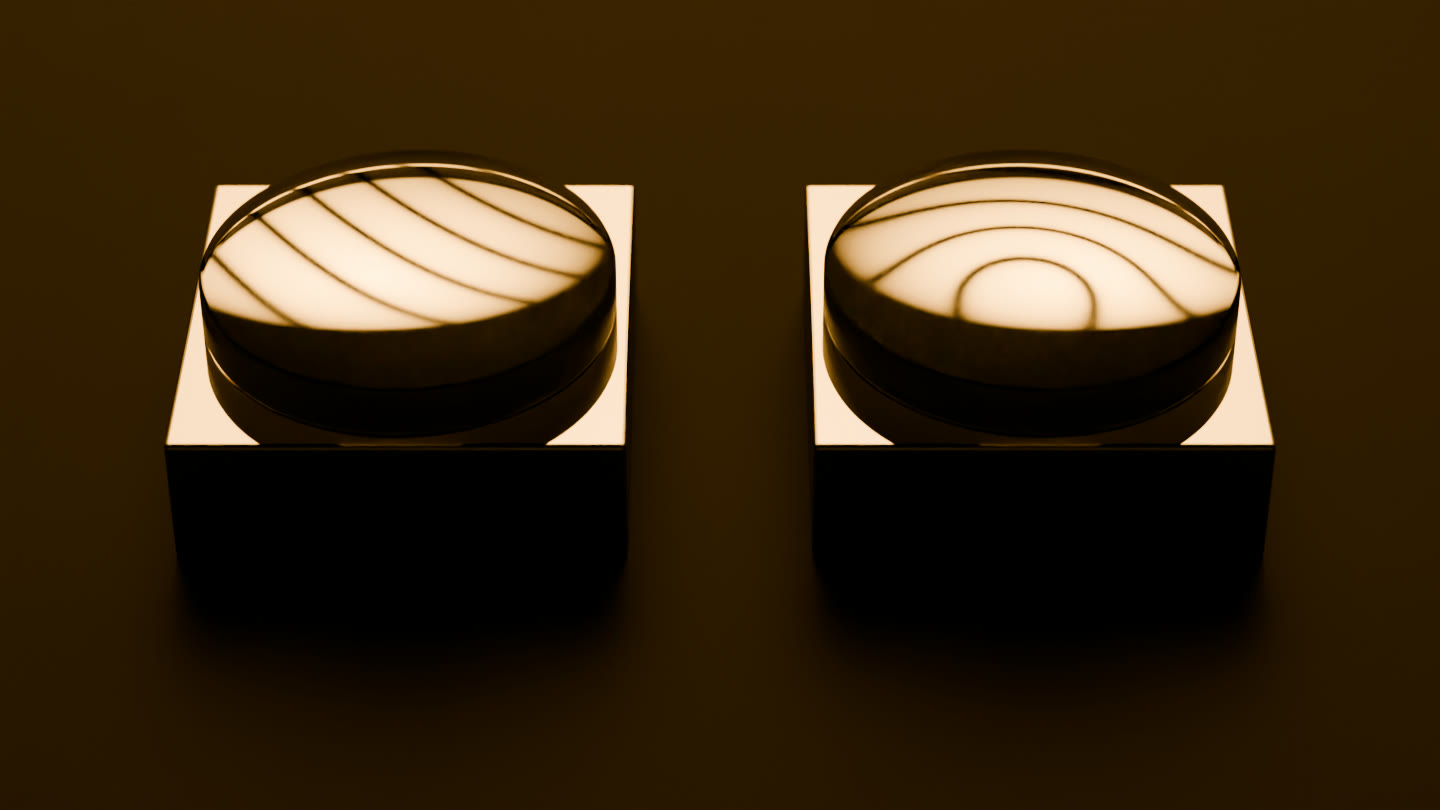
The steel, the glass and the light around the fringes are the film’s own, rendered once at five reflectances; the fringes are computed here, as you press, and the picture is blended at the reflectance they give. This browser could not run it; the picture above is the film’s.
AI makes answers, numbers and parts that look right. Looking right is not a test.
The model proposes.
The system decides.
CytherAI builds the part of AI that decides what is allowed to happen: checks that stand outside the model, as the glass stands outside the steel.
How it was made
This is a rendering, made in Blender with Cycles on an Apple M4, and every fringe in it is computed, not drawn. For each frame, each point of each block asks what an optical flat would show there: the reflectance of the stack of glass, a 15-nanometre silver film, the air gap and the steel, every reflection inside it counted, for the two yellow lines of sodium, at the gap the scene sets at that instant, its phase taken at the camera’s own angle, through its own lens. The reflectances themselves are computed at normal incidence, an approximation for a camera that looks down at an angle, and the steel is given iron’s constants.
The flats are partially silvered, as the flats of gauge interferometers were, which sharpens the fringes. Each one lands, presses out its film of air and comes to rest on a slight wedge; the wedge sets how far apart the lines lie. The second block’s rise is a smooth dome 1.2 micrometres high. No fringe was placed by hand.
The optical constants are published measurements: fused silica (Malitson, 1965), iron (Johnson and Christy, 1974) and silver (Johnson and Christy, 1972), from the refractiveindex.info database. Two independent ways of computing the stack, the Airy sum and characteristic matrices, give the same reflectance for an unsilvered flat, between 0.382 and 0.640. That agreement, like this page’s with the film, checks the computation, not the model.
What it is not
A rendering, not a photograph. The blocks, the dome and the wedges are ours; the physics is not. In the scene the flats are perfect, so straight, parallel, evenly spaced lines mean the first block is flat; in a real inspection they mean it is flat to within the reference flat’s own accuracy. A real inspection would also meet dust, warmth and the hand that lays the glass.